


As ISIS fighters and their families were surrounded and making their last stand in Syria in late 2018, a Canadian woman who was allegedly there with them sent a defiant text to her mother.
“Allah has written that victory is near,” Ammara Amjad wrote, according to the RCMP, which found her messages on a phone seized during a search of her parents’ home north of Toronto.
Eight years later, the 32-year-old mother of two sat in a courtroom in Brampton, Ont., last week while a jury heard evidence of her alleged involvement in the Islamic State terror group.
The Canadian government brought Amjad back from a Syrian detention camp in 2023, along with her children, both born after she allegedly left home and made her way to ISIS territory.
She now faces a charge of participating in the activities of a terrorist group. It is the first prosecution of a Canadian woman accused of living under ISIS as it committed untold atrocities.
To impose its bleak ideology, the jihadist group massacred and enslaved Iraq’s Yazidis, executed captives on video and facilitated attacks in Western countries, including Canada.
As a result, security agencies have warned that ISIS members returning to Canada following the group’s defeat in Syria are likely to pose a threat, and could commit attacks or radicalize others.
Two other women, B.C. resident Kimberly Polman and Montreal’s Oumaima Chouay, have pleaded guilty. Canada repatriated six more ISIS women from Syrian camps, but they have not been charged.
Since Amjad’s trial began on Oct. 22, much of the evidence has consisted of messages she exchanged with her mother — so many that it took the RCMP a year to translate them from Urdu, Pakistan’s national language.
In some of the estimated 10,000 texts and audio files, Amjad repeatedly pleaded with her family in Milton, Ont. to send money, and spoke of her decision to leave Canada as a religious duty.
“This is in the cause of Allah,” she wrote in an April 2018 message, according to RCMP Const. Ragiv Chaudhary, who translated most of the messages.
“You deceived us all, left us in tears,” her mother countered.
“I did not deceive,” Amjad responded. “Everyone should have taken this step.”

Spanish police with white van ISIS member used to kill more than a dozen people, including two Canadians, in Barcelona on Aug. 17, 2017. (AP Photo/Manu Fernandez, File).
The Canadian courts have convicted a growing number of men who fought with ISIS or plotted attacks, most recently in Ontario and B.C. But Amjad’s case is a test of whether Canada can bring to justice the women who were also part of ISIS.
The trial focused initially on the role of women in the Islamic State, with an expert testifying they were mainly housewives and mothers to the next generation of jihadist fighters.
Prof. Guido Steinberg said some foreign ISIS women were also given weapons training, and an all-female fighting unit was later established, but added that those caught trying to flee were often punished.
The trial also turns on the reliability of “battlefield evidence,” also called Collected Exploitable Material, which is the information taken from documents and electronic devices found in Syria.
But the Crown’s case appears to hinge largely on Amjad’s own statements in the text messages and voice recordings she sent to her mother from Syria, while the defence is challenging the accuracy of RCMP translations.
Read aloud in court by the multilingual RCMP officer who translated most of them, they allegedly chronicle Amjad’s journey through the rise and fall of ISIS.
They also show how Amjad’s exasperated mother tried again and again to appeal to her headstrong daughter to get out of Syria after her first child was born.
“You are not using your brain,” her mother wrote at one point, according to the messages read into the court record by the RCMP officer. “Parents come before anyone else.”
“Parents do not come before Allah,” Amjad replied.
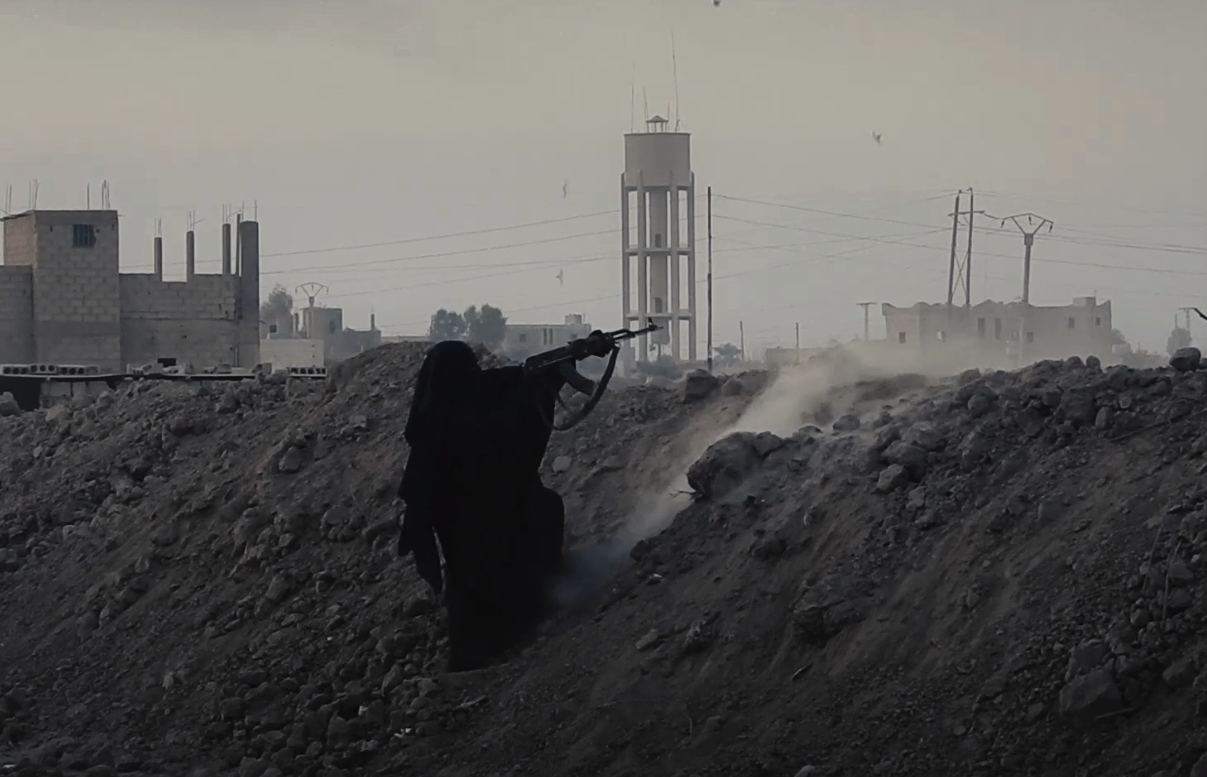
Screenshot from ISIS propaganda video.
Like many of the dozens of radicalized Canadians who flew to Turkey and crossed into Syria to live under ISIS, Amjad had a privileged upbringing, the messages suggest.
“You were living in peace and joy, you had everything,” her mother wrote to her in August 2018.
“You guys don’t understand,” Amjad wrote. “This was very important work for me and all the Muslims. But not everyone will do it. Not everyone will support the right.”
“We are here for the law to apply.”
Amjad’s messages suggest she followed her first husband to Syria. In the texts, she named him as Bilal. The Canadian military has confirmed that a former reservist by that name joined ISIS.
Bilal Khan was a private in the Royal Hamilton Light Infantry in Hamilton, Ont. but was released from the army in October 2014, the Canadian Armed Forces told Global News.
Despite his military training, he did not last long in Syria, dying within months of arriving in ISIS-controlled territory. Amjad appears to have then married another ISIS fighter named Hamza.
The court heard testimony that Hamza Parvez was a British-Pakistani ISIS member who, according to the terror group’s own extensive paperwork, entered ISIS territory from Turkey in 2014.
Calling himself Abu Hamza al-Britani, he posted anti-Western screeds on social media. His online posts about missing junk food made him fodder for the British tabloids, which dubbed him “Hungry Hamza.”
The Daily Mail described him as a “cat-obsessed ISIS fighter from London who dreams about KFC and Nando’s while waging jihad,” adding that fellow jihadists had “advised him to stop eating so much ice cream.”
“I travelled to Syria to make jihad. I won’t lie,” Parvez told Sky News last year from the prison where he was then held by Kurdish forces. Asked if he had been an ISIS fighter, he reportedly smiled.
In her messages to her mother, Amjad said Hamza liked cooking in the clay oven in their backyard. “He’s a wonderful husband, exactly the kind I wanted. Intelligent, funny and caring,” she wrote.
But he was apparently upset by talk of Amjad’s first husband. “You shouldn’t mention Bilal over and over again,” Amjad told her mother. “Hamza and I always listen to all the voice messages together, and he doesn’t like it.”
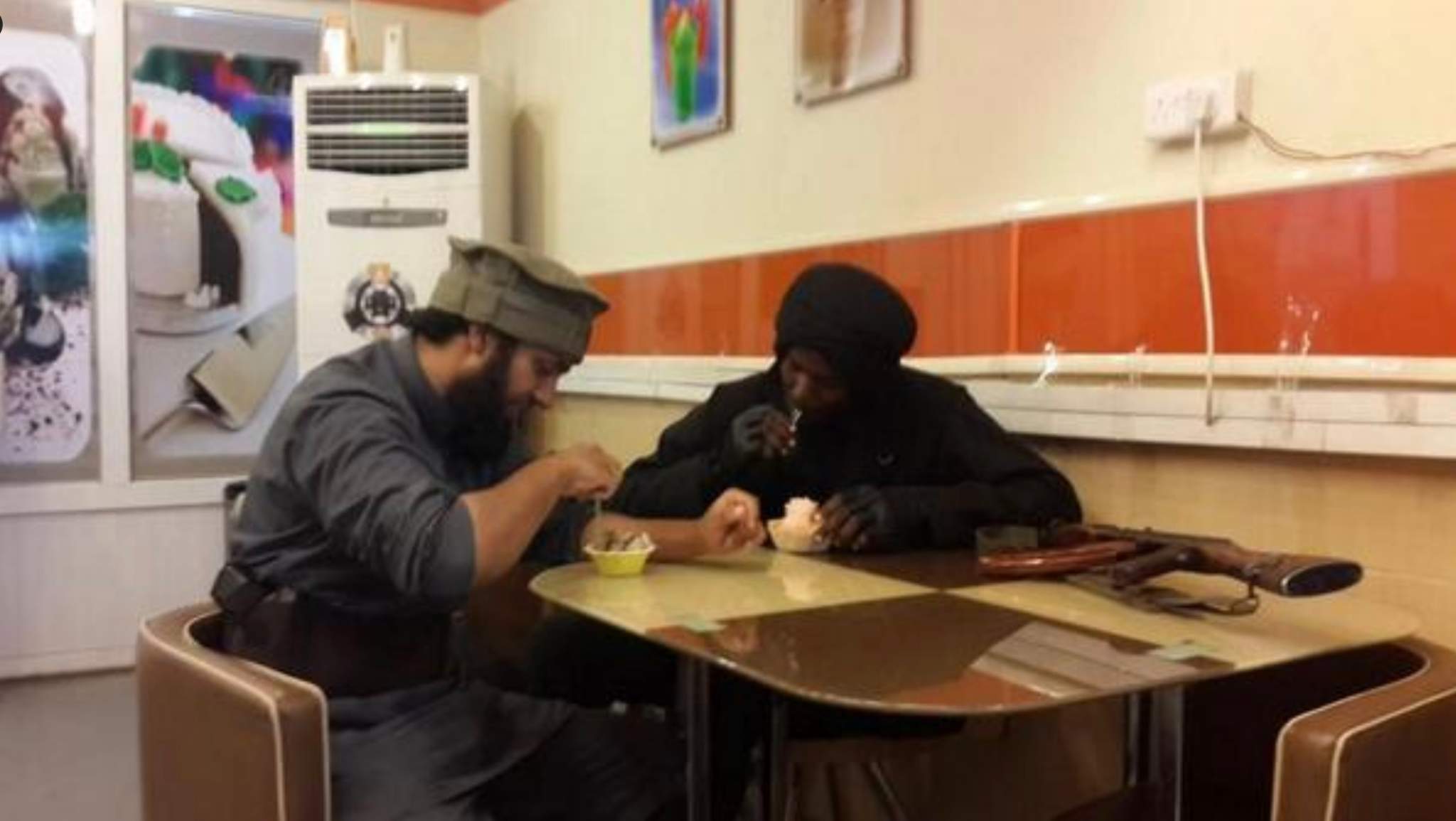
British ISIS member Hamza Parvez, left, in Mosul, Iraq, 2014.
Many of Amjad’s messages to her mother were requests for money, which she framed in religious terms, suggesting that if her family didn’t pay now, they would pay in the afterlife.
“Please send me dollars,” she wrote in one message, explaining that she needed a new phone and wanted to get internet service installed in her home.
“You have savings, you have been spending money on shopping for a long time. Father has savings, where else will he spend it?” she wrote.
She said she deserved it because her parents didn’t have to pay for her wedding. But her mother responded that it was risky to send money and “everyone is worried about getting caught.”
“How long will this go on,” her mother wrote in a response to one of Amjad’s pleas for cash. “You have to keep asking for money again and again.”
“This is the last time.”
Amjad wanted her family to send the money through South Africa, and spoke about going to Pakistan. She rejected returning to Canada, writing that authorities would put her son into foster care with “white people.”
Her mother encouraged her to contact Turkish President Tayyip Erdogan, whom she said was a “kind person” who might give her asylum. “Tell him what you have done wrong.”
But even as ISIS was headed for certain defeat in late 2018, Amjad stuck to the far-fetched belief that victory was assured, writing that the challenges they were enduring were only a test from God and that only “hypocrites” fled.
She said they were surrounded but that God was protecting them and had created a sandstorm that had forced the U.S.-backed anti-ISIS Kurdish forces to temporarily pause their offensive.
“Allah turned around everything,” she wrote.

Member of Kurdish-led Syrian Democratic Forces directs woman waiting to be searched after leaving last ISIS holdout of Baghouz, Syria, March 1, 2019. (Photo by Delil SOULEIMAN / AFP).
In early 2019, U.S.-backed Syrian Kurdish fighters pinned the remnants of ISIS against the Iraqi border, an offensive known as the Battle of Baghuz. Routed, the surviving ISIS fighters and their families were captured.
Amjad was among the thousands of foreign citizens sent to the Al Hol and Al Roj detention camps for ISIS women and their kids in Kurdish-controlled northeast Syria.
“I have arrived in the camp now,” she wrote to her mother on March 28, 2019. “I’m in the Al Hol camp and Hamza is somewhere else.”
“Everything is finished.”
When the British tabloids found out Parvez had been imprisoned, the headline in the Mirror read, “Brit ISIS fanatic Hungry Hamza who moaned about missing KFC captured in Syria.”
Amjad had spent more than four years in the crowded detention camps when a Global Affairs Canada delegation finally travelled to northeast Syria to secure her release.
She landed in Montreal in April 2023, along with three other women and their children who had been freed at the same time and repatriated at significant public expense.
Released on bail, Amjad was ordered to obey a list of conditions that included house arrest at her parents’ home. She was also banned from contacting Hamza Parvez and five other Canadian ISIS women.
Her trial resumes on Monday.