

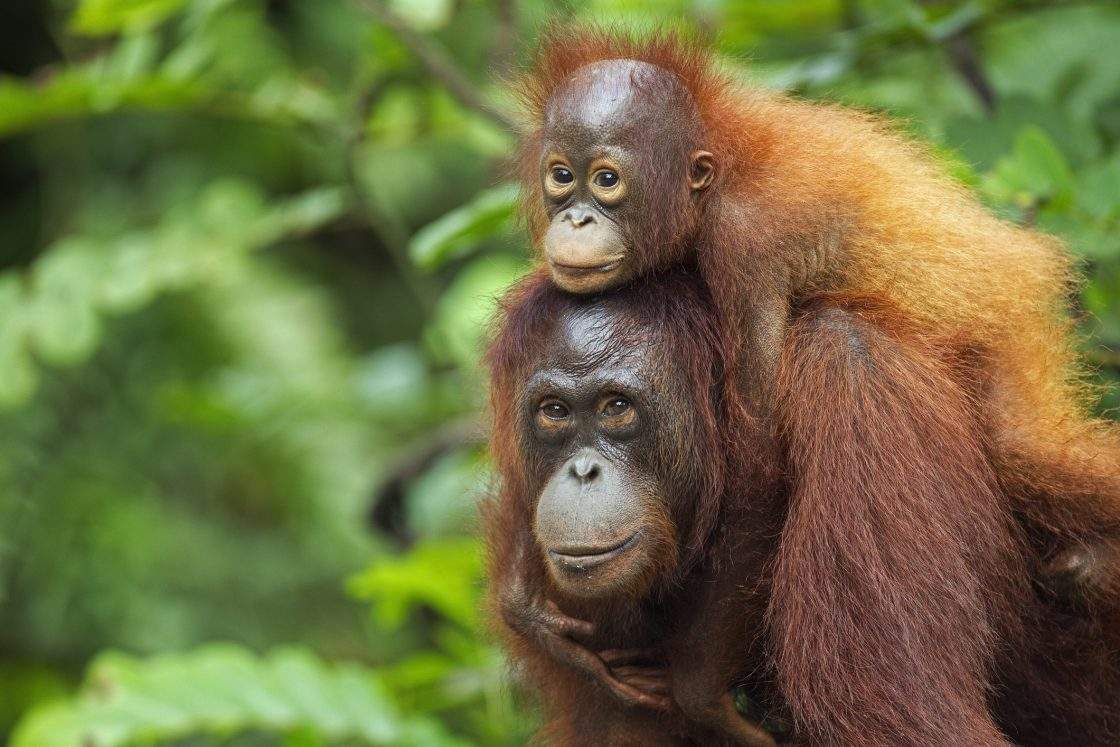
A group of baby orangutans has been found in a forest in India, thousands of kilometres from their natural habitat, sounding the alarm about possible illegal smuggling.

Orangutans are native only to Borneo and Sumatra, two islands in southeast Asia, and are distinct for their sparse reddish-orange fur and long, powerful arms. Their presence in Odisha, an eastern Indian state on the Bay of Bengal, prompted environmental officials in the region to open a trafficking investigation.

World’s only-known albino orangutan returns to the wild
“We suspect that an international racket might be involved in this,” Odisha’s environment minister, Ram Singh Khuntia, told the Indo Asian News Service.
The five babies were discovered by forest department officials who were patrolling the Jaleswar range in Balasore district, The Guardian reported.
Officials suspect the orangutans were in the area for a few days before they were found, and have since been placed in quarantine at a state zoo, the U.K. newspaper said.
The species is critically endangered, and the Convention on International Trade in Endangered Species of Wild Fauna and Flora makes it illegal to trade orangutans commercially.
Footage of the babies has circulated online, showing park rangers feeding the infants fruit and milk as they play among themselves.
Balasore Divisional Forest Officer Pratik Prakash Indalkar told The Indian Express that the babies — three males and two females — were rescued earlier this week and taken for medical exams at the Nandankanan Zoo.
“We have rescued 5 baby orangutans and brought them to the forest office. 4 of the 5 babies are healthy. Veterinary doctors are examining and treating them,” he told the outlet, adding that the babies have been put on a special diet; two of the smaller ones are eating mostly mashed potatoes and mashed apples, while the slightly older siblings can take solid foods.
According to the World Wildlife Fund, there are about 104,700 (Bornean), 13,846 (Sumatran), and 800 (Tapanuli) orangutans left in the wild. In the last 100 years, the population has declined significantly, compared with the estimated population sitting at about 230,000 a century ago.
The Tapanuli orangutan, a third species announced in 2017, is the most endangered of all great apes. About seven per cent of the population was wiped out last year in severe flooding in Indonesia, according to a June Reuters report.
At least 58 Tapanuli orangutans, which are endemic to an area around north Sumatra’s Batang Toru forest, were killed in the floods, the report said, citing a survey of the western block of the forest that is home to a majority of the total population of 800 primates.
Their livelihoods are also threatened by poaching, mining, palm oil plantations and a hydropower construction project in the western block of the forest, as well as human-induced climate change.
Humans and orangutans share 97 percent of their DNA; this compares to about 99 percent similarity between humans and chimpanzees, according to the National Institutes of Health.
Sequencing of the orangutan genome revealed that the species evolved much more slowly than its close relatives, chimpanzees and humans, over tens of millions of years.
— with files from Reuters
© 2026 Global News, a division of Corus Entertainment Inc.