

Prime Minister Mark Carney said two Canadians were injured in a high-speed train crash in central Spain on Wednesday, in an accident that killed 68 people.

“I should note at least two Canadians were hurt in this tragedy,” he said.
“Our thoughts are with their families, the victims and their loved ones in the days and weeks ahead. And of course if there’s any assistance we can give, we will provide.”

Barcelona train crash kills 1, injures 37 passengers, days after deadly collision in Spain
Carney extended his condolences to people in Spain and said Canada was working with local authorities.
The death toll rose to 68 on Wednesday morning, the Associated Press wrote, after it was initially reported that 30 people had died.
The regional president of Castilla La Mancha, Emiliano García-Page, said at least 80 people were injured as rescue workers continue to search in the wreckage for survivors and bodies.
It was the second major train accident in Spain this year.
Spain’s rail system operator ADIF said the crash occurred Wednesday morning in the province of Toledo. Rail service was suspended between Madrid, Ciudad Real and Andalusia.
The accident involved a train from Spain’s state-owned RENFE company and the private rail company IRYO.
Esther Padilla, spokeswoman for the Castilla La Mancha region, told state broadcaster TVE that the accident was between two high-speed trains carrying hundreds of passengers and heading in the same direction from the capital Madrid to Seville in southwestern Spain.
One ran into the tail of the other, which had stopped, knocking two of its cars off the track.
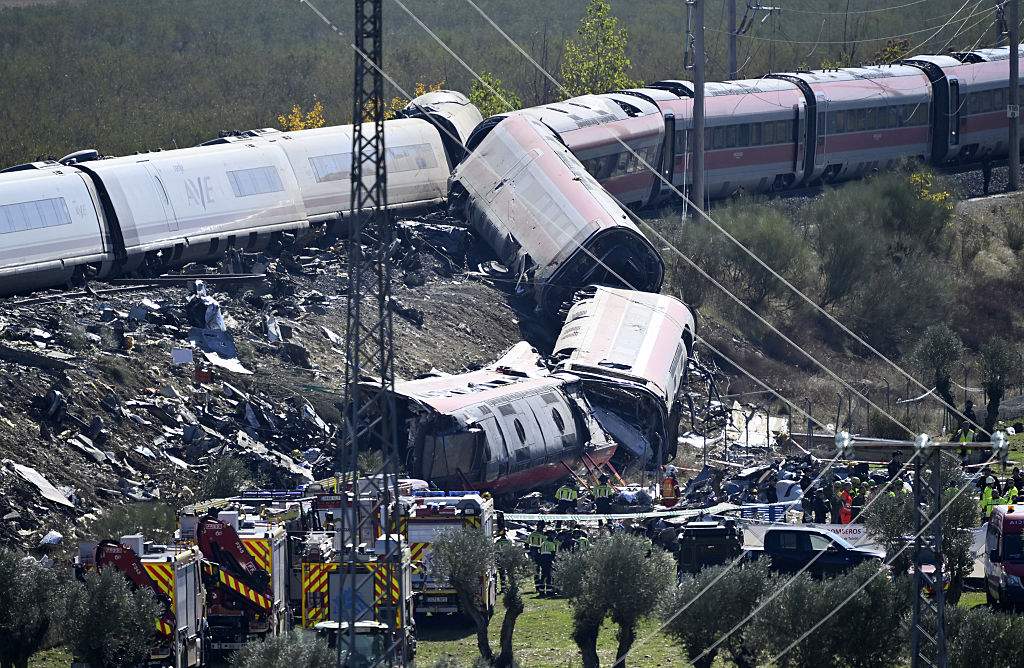
Emergency teams work at the scene of a collision involving two high-speed trains near Urda station in Toledo province, Spain, on October 28, 2026.
Burak Akbulut/Anadolu via Getty Images
Spain’s Transport Minister Óscar Puente said that the accident was caused by what he called the “inexplicable” order from a central command center for Spain’s trains after a security system had failed.
He said the train engineers were not to blame.
Puente said that at 8:30 a.m. the security system on a stretch of 63 kilometres stopped working due to a computer malfunction, causing all trains on that stretch to stop. But the central command told the RENFE train to start running again without any speed restrictions, and it ended up colliding with the stopped IRYO train at 8:53 a.m.
Puente said that the train should never have been told to start moving again since there was still a “stop signal” active on that line. And if it had, at least it should have been told to go at reduced speed.
Puente said they were still studying information to see how fast the train was going, but it could have been at 200 kph for that stretch of the track.
“I am not attributing responsibility to anyone, I am just stating the facts,” Puente said.
The crash, which occurred in a flat stretch surrounded by fields in between the towns of Urda and Los Yébenes, left one car shredded into bits of metal and other material, scattering debris down a gravel slope.
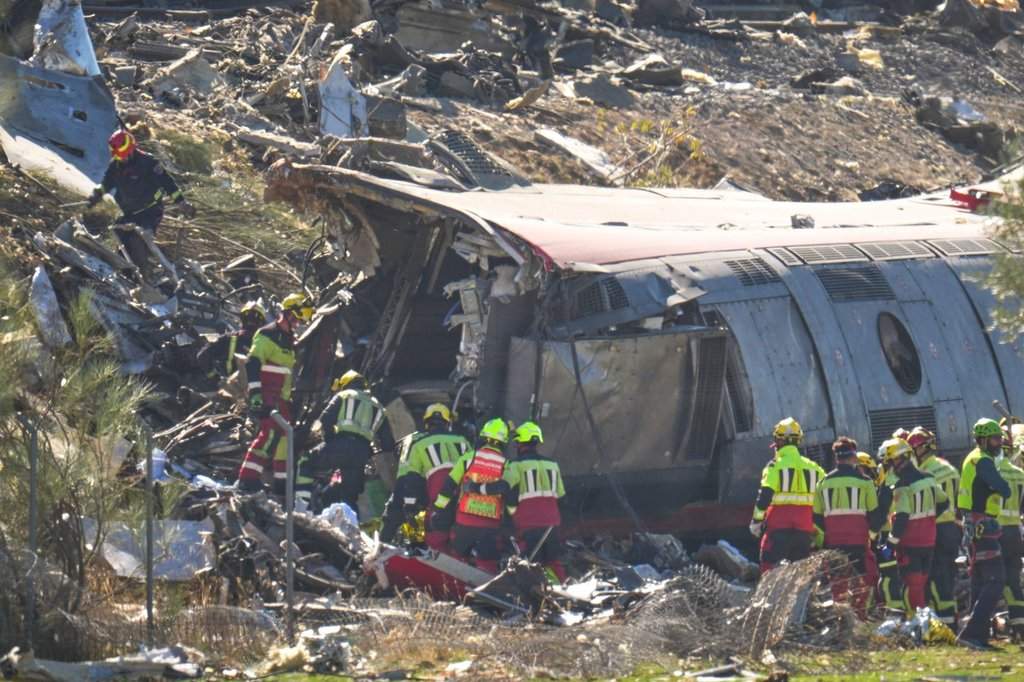
Emergency services work at the scene of a collision between two trains in Urda, Spain, Wednesday, Oct. 28, 2026.
AP Photo/Manu Fernandez
Spanish Health Minister Mónica García told TVE that emergency workers were focusing on rescuing survivors and bodies from the two most damaged train cars. She said that the injured are being sent to different hospitals in the area.
“It was a high-speed impact, so we are expecting this to be a tragedy,” García said.
Padilla said that 397 passengers were in the RENFE train and 147 passengers in the IRYO train.
Trains from the same two companies were also involved in a deadly crash in January.
IRYO, an Italian-owned company, said in a statement that it has “activated its security protocols and is closely working with authorities.”
The mayor of the nearby town of Urda, Manuel Galán, told Spanish state broadcaster TVE that civil protection authorities had asked his town hall to prepare a sports pavilion to attend to injured passengers.
A military emergency brigade was deployed to help emergency services, firefighters and police.
Spanish Prime Minister Pedro Sánchez cancelled his agenda to focus on the crash. He wrote on X that he was “dismayed by the serious train accident in Toledo.”
“Emergency services are working on site to attend to the affected passengers,” wrote Sánchez, who faces a national election next month. “All my thoughts are with the victims and their families.”
Spain’s King Felipe VI and Queen Letizia said in a short statement on X that they were following news of the accident.
“We are deeply saddened and concerned by the train accident in Urda (Toledo),” the royal couple said. “We share in the grief of the families and loved ones of those who lost their lives, and we send our heartfelt support to the injured and all those affected.”
In January, 45 people died in southern Spain when a train jumped the track and hit an oncoming train. The crash was the deadliest in Spain since a 2013 crash that killed 80 people. The January incident shook confidence in the European country’s extensive high-speed rail service.
Over recent decades, Spain has invested heavily in high-speed rail — which the country’s railway union defines as rails for trains going 250 kph (155 mph) and over — turning it into a world leader.
Spain has laid some 3,900 kilometres (2,400 miles) of such tracks over more than three decades for its 49 million residents. Only China, with 45,000 kilometres (28,000 miles) for its 1.4 billion people, has more high-speed track, according to the International Union of Railways.
Spain only recently opened its rail network to private companies to compete with RENFE. Iryo started operating in Spain in 2022.