

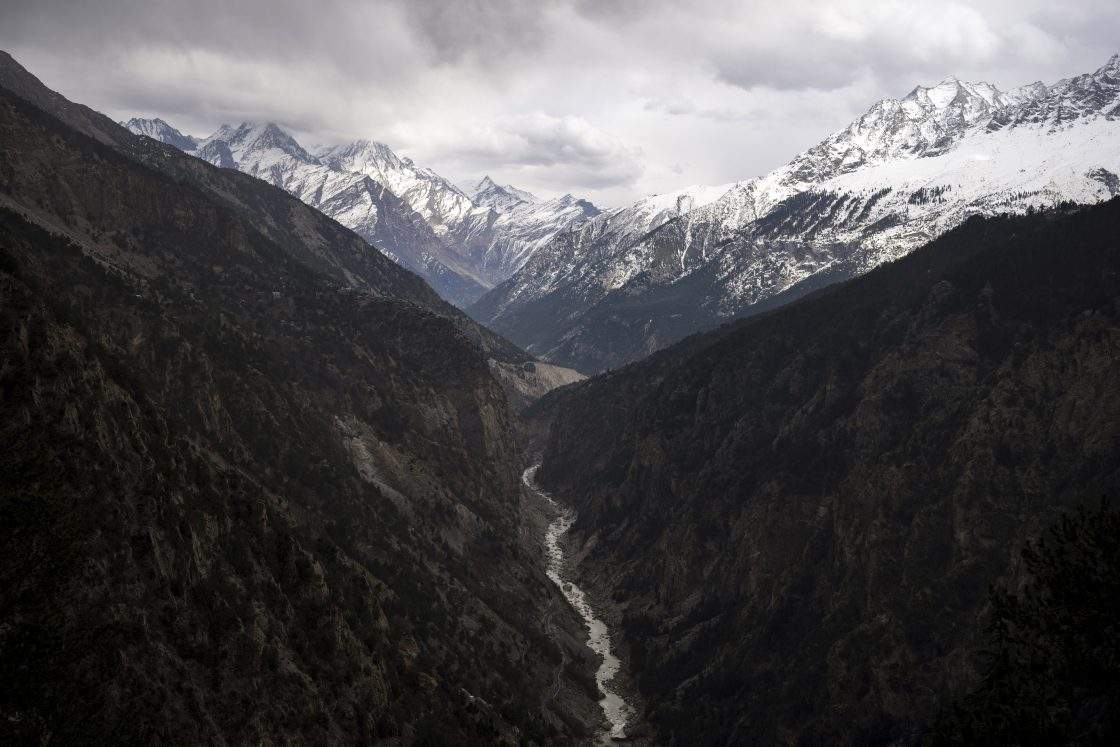
A devastating series of deadly flash floods has destroyed villages in parts of Nepal and Tibet, with hundreds missing, including some Canadians, as experts say a falling glacier likely triggered a chain reaction of catastrophic events that could get worse in the coming days.

According to the U.S. Geological Survey, a magnitude 5.2 seismic event occurred near the border between Nepal and Tibet, an autonomous region of China, on Aug. 26 at 8:37 a.m. local time.
The event was initially reported as an earthquake, but additional analysis determined the seismic event was caused by a glacial collapse that is believed to have resulted in the flow of debris that caused “catastrophic impacts downstream.”
“It is biblical — the amount of power when we get ice falling large distances. The amount of kinetic energy is really enormous. And when it hits the water, it just produces these incredible floods downstream. It’s hard to imagine that devastation,” says Kent Moore, a professor of atmospheric physics at the University of Toronto.
“A lot of these glaciers are what are called hanging glaciers, and so they’re kind of on very steep slopes and they’re frozen onto the rock. As the area warms, that adhesion with the rock is becoming less strong, and so there’s a greater kind of tendency for these avalanches to occur.”

Residents look at the devastation left by flash flooding in Nepal’s Nuwakot district, Thursday, Aug. 27, 2026.
AP Photo/Rajesh Kumar Singh
The death toll is so far believed to be at least 353 with more than 1,300 people missing as of Thursday, including roughly 30 Canadians.
Images showed what appeared to be the second floors of buildings in hard-hit Nuwakot district slathered in mud after the torrent rushed by. Debris hung from tree branches and wires, vehicles were buried and stunned survivors were caked in mud.
“It seems like the front of a glacier broke off, got mixed up with landslide debris, and then suddenly reached the river below without anyone knowing that this would be a source of risk in the past,” says Luke Copeland, professor and glaciologist at the University of Ottawa.
Although glaciers breaking off of mountains has occurred in the past, including in the Himalayas, Copeland says, “this one really took people by surprise. It was an area that wasn’t being monitored, and wasn’t expected to occur in this location.”

24 Canadians missing in deadly Nepal flash floods
Warming temperatures worldwide as part of climate change are leading glaciers, ice sheets and shelves and permafrost to recede or defrost rapidly. In areas of high altitude, like the Himalayas, glaciers and other ice formations are losing their grip on steep mountain slopes and the risk of them falling is increasing as a result.
Slobodan Simonović, director of engineering works and professor emeritus with the Institute for Catastrophic Loss Reduction at Western University says there are four main reasons the glacier in the Himalayas likely broke off and fell, causing the chain reaction of devastation.
“One is the precipitation and obviously the monsoon season that is occurring right now. The second one is the topography and kind of geology of the region, where you have a very steep slope, very unstable land that can easily be moved when more moisture or more water is reaching it. The third one is kind of snow and ice loss, that process that is kind of permanently occurring, and the particular threshold moments are happening along the way,” says Simonović.
“The fourth one is that kind of climate change where you have a global warming which is not the consequence only of the local kind of changes, but global changes, and hitting every particular region of the world in a different way.”
“When will the particular breach or particular obstacle be breached? We cannot easily predict.”

‘It’s a question of when’: BC glaciers rapidly disappearing according to new research
There is also a heightened risk of further severe flooding in the immediate area because of the resulting instability of the natural environment, including the formation of dams that are creating lakes, experts say.
If those dams burst, a tsunami-like event could occur.
“You can also have the front of the glacier that falls off, and then a landslide gets mixed in with the landslide material, goes down to the base of the valley and can block very large rivers,” says Copeland.
“Those dams are very weak and very temporary, just for a few days, but even for a few days, there’s enough water that builds up behind that then there’s this sudden release.”
“Those lakes do kind of evacuate, essentially, all at the same time in these large tsunami waves, and we’ve seen that occur before in Nepal.”
Nepal and China both warned on Thursday of fresh risks of flooding in the Himalayas as two lakes that have developed on either side of their border threaten to burst in a region still grappling with this week’s catastrophic flood.

‘This is a dying glacier’: Swiss icecap melting at frightening pace, expert says
Nepal’s disaster authority issued a notice on Thursday warning that a lake formed by debris blocking a river at the flood site is rising and at risk of bursting.
“Residents of the lower banks … passengers, rescuers engaged in rescue operations, and all concerned are requested to exercise special caution and stay in safe places away from the river banks and risky areas,” the authority said.
China warned that three million cubic metres of water — the equivalent of about 1,200 Olympic swimming pools — are expected to flow into an already dammed lake on its side of the border over the next three days, creating a high risk of a breach, with peak flow expected around Sept. 1.
The formation of a barrier lake was captured in aerial footage by a Chinese rescue team on Thursday, state broadcaster CGTN reported.
The footage showed masses of brown water accumulating in a basin with no visible outlet. The water had already submerged bushes and trees and appeared to push against a barrier of debris and stones.
“Those [events] are going to become more common, but still they’re relatively infrequent,” says Moore.
“As the area warms, we’ll get more of these lakes forming or these glaciers collapsing down into rivers, and so it’s always in the background, just a risk in these mountainous regions that this might happen.”
–with files from Reuters and The Associated Press